Work
I build products at the intersection of complex systems, regulated industries, and human workflows—the kind of infrastructure where getting it wrong has legal and financial consequences, not just a bad NPS score. Over three years at AgentSync, I was the only PM to work across every team—Manage (the core product), Data Platform (the infrastructure product), and Contracting (the new, big bet product). Each mandate was different: stewarding a core revenue platform, building data pipelines and carrier integrations, and taking a distribution product enterprise-ready. Across all three, the through-line was the same—translate complexity into something that actually works at scale. One lens I bring to every product today: where does AI create a step-change in what's possible, not just an incremental improvement? In compliance infrastructure specifically, the shift from batch to real-time intelligence—flagging risk before it becomes a violation, surfacing obligations before a signature, predicting churn before it shows in the data — is still largely unbuilt. That's where I'd focus next. Before AgentSync, I worked at Homebot on products that helped homeowners and lenders make smarter decisions about real estate, and as a product consultant alongside Fortune 500 companies and Big Three Consulting firms. This all follows eight years as a corporate real estate attorney at some of the largest law firms in New Zealand, Australia, and the UK.
Case Study 1: Making Insurance Contracting Enterprise-Ready
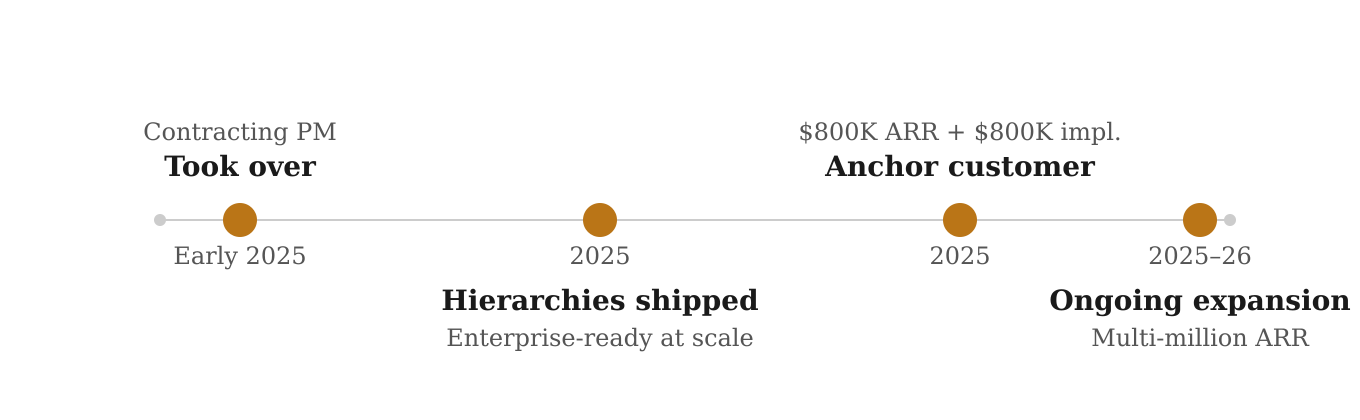
AgentSync Contracting · Contracting PM · Early 2025–Jan 2026. See the product: AgentSync Contracting
The problem I owned
Our anchor enterprise customer managed thousands of agents across a complex multi-level hierarchy — sub-agencies rolling up to managing general agents rolling up to the distributor. Insurance distribution hierarchies aren't just an org chart problem. Get them wrong and the wrong agents sign the wrong contracts, which in a regulated industry creates legal and compliance exposure, not just a UX issue.
Beyond the hierarchy gap, the product had friction at every layer: login issues blocking agents from completing contracts, workflows that degraded under volume, and no way to handle the kind of exception management that enterprise operations generate at scale.
Context
AgentSync Contracting managed the producer-to-carrier contract execution workflow — the process by which agents sign, complete, and submit the forms required to sell a carrier's products. When I took over as Contracting PM in early 2025, the product worked. But it wasn't enterprise-ready, and we had a large enterprise customer whose requirements were about to test every assumption baked into the existing architecture.
What happened
The anchor enterprise customer became an $800K+ ARR account with an additional $800K in implementation fees. The Contracting product grew into a multi-million dollar ARR line of business across a range of distributor customers, from $40K to $200K ARR each.
What I did
The first thing I shipped was a hierarchies product embedded within Contracting — a way to model the full organizational structure of a large distributor, so the right contract forms flowed to the right agents at the right level. This required deep domain work on how insurance distribution actually functions legally and operationally — territory where my background in commercial law gave me a genuine head start.
In parallel, I rebuilt core workflows for scale: bulk operations, status visibility across thousands of in-flight contracts, and exception handling that didn't require manual intervention. I also led integrations between Contracting and the enterprise customer's own policy administration systems — a technically complex build that required sustained collaboration between product and engineering across both sides.
What I'd do differently
I'd have pushed earlier for a cleaner separation between the configuration layer — what distributors set up — and the execution layer — what agents experience. We built features that mixed those concerns, which created downstream complexity every time a new carrier form type came in.
With what's available today, I'd also explore AI-assisted contract comprehension at the agent level. Insurance contracts are dense, highly technical documents. LLMs are now genuinely good at surfacing the key obligations, flagging unusual terms, and answering agent questions inline before they sign. That's a feature that reduces errors, speeds completion rates, and makes the product meaningfully better for the end user — not just the administrator. We were treating contract forms as static documents to be signed. They're structured data to be reasoned over. That's a different and more powerful product.
Case Study 2: Building the Data Layer of Insurance Distribution
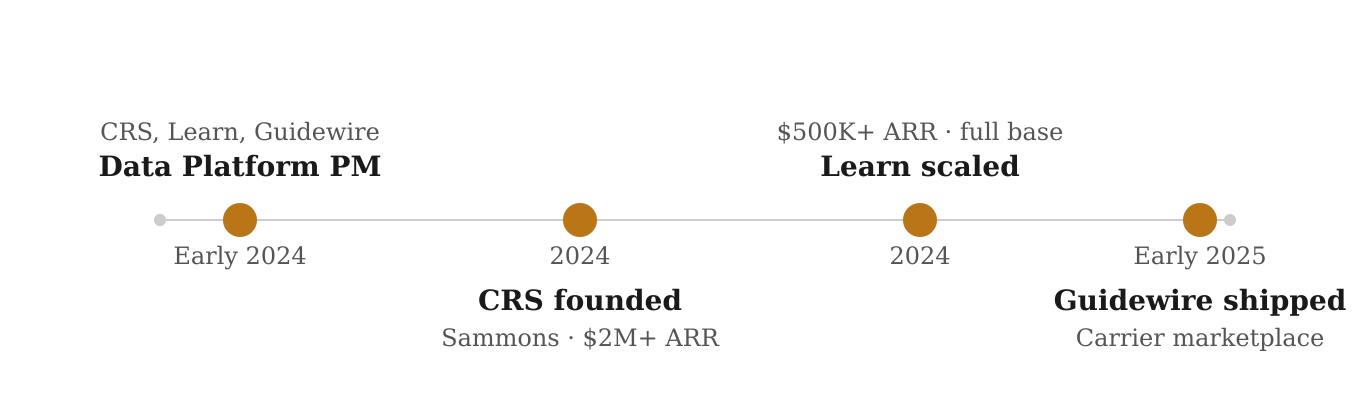
AgentSync Data Platform · Data Platform PM · 2024–Early 2025
The problem I owned
Large Life & Annuity carriers were receiving contract request data from multiple sources — DTCC LnA, SureLC, homegrown systems — in inconsistent formats, requiring compliance teams to manually decipher and re-enter data. This wasn't just inefficient. It was a blocker to scale. And critically, building CRS was a contractual commitment we had made to land the company's largest customer at $2M+ ARR. There was no fallback plan.
For Learn, the problem was different: a solid product with real market fit that wasn't being activated fast enough across the customer base. CE compliance is a requirement for every producer on every platform — the addressable market was the entire AgentSync customer base — but too many customers were buying it and not getting to value quickly enough.
Context
After my Manage mandate (the core product case study below this one), I moved into a dedicated Data Platform PM role — focused on data as a product: pipelines, quality, and integrations serving multiple consumers across the business. My portfolio covered three products: the Contract Request Service (CRS), AgentSync Learn, and the Guidewire PolicyCenter integration.
What happened
CRS landed a reputable L&A carrier at $2M+ ARR — the company's largest customer at signing. Learn became a $500K+ ARR product adopted across the full customer base, and a standard part of the AgentSync sales motion rather than an optional upsell. The Guidewire Marketplace listing represented a strategic expansion from the agency side of the market into certified carrier infrastructure.
What I did
For CRS, I was the founding PM. I defined the product from the ground up: a source-agnostic data normalization layer that ingested contract request data from DTCC LnA and SureLC, standardized it on ingestion, and integrated it directly into AgentSync Manage — eliminating manual data entry, reducing compliance errors, and accelerating producer onboarding at the carrier level.
For Learn, my role was as much commercial as it was product. I demoed directly to customers continuously — not as a handoff to Sales, but as a genuine co-selling motion where my product depth was the differentiator. I worked closely with our WebCE data partnership to ensure coverage and reliability of the underlying CE data, and collaborated with Customer Success to build onboarding and monitoring workflows that made the product sticky post-sale. On the product side, I prioritized features that reduced the most friction in the compliance workflow: CE verification before renewal submission, large-scale reporting for compliance teams, automated reminders with audit trail logging, and real-time CE warning states.
For Guidewire, I led the AgentSync Accelerator for PolicyCenter — a certified integration that synchronized producer compliance data from AgentSync into Guidewire in real time, enabling carriers to run compliance checks during quoting and binding. This shipped to the Guidewire Marketplace, opening AgentSync to a net-new segment of carrier-side buyers.
What I'd do differently
For CRS, I'd have negotiated more explicit milestone definitions upfront with the L&A carrier team. Building against a contractual commitment to your company's largest customer is high-stakes by definition—ambiguity in that environment creates sprint-level pressure that good upfront definition work absorbs early.
For Learn, the biggest leverage was always in activation, not features. Today I'd instrument the onboarding flow with AI-powered intelligence: surfacing which producers are CE-at-risk before the compliance team has noticed, generating personalized renewal timelines automatically, and triggering interventions before a producer falls out of compliance rather than after. The underlying data was already there. The intelligence layer wasn't—and it's entirely buildable now.
Case Study 3: Co-stewarding a $30M ARR Core Platform
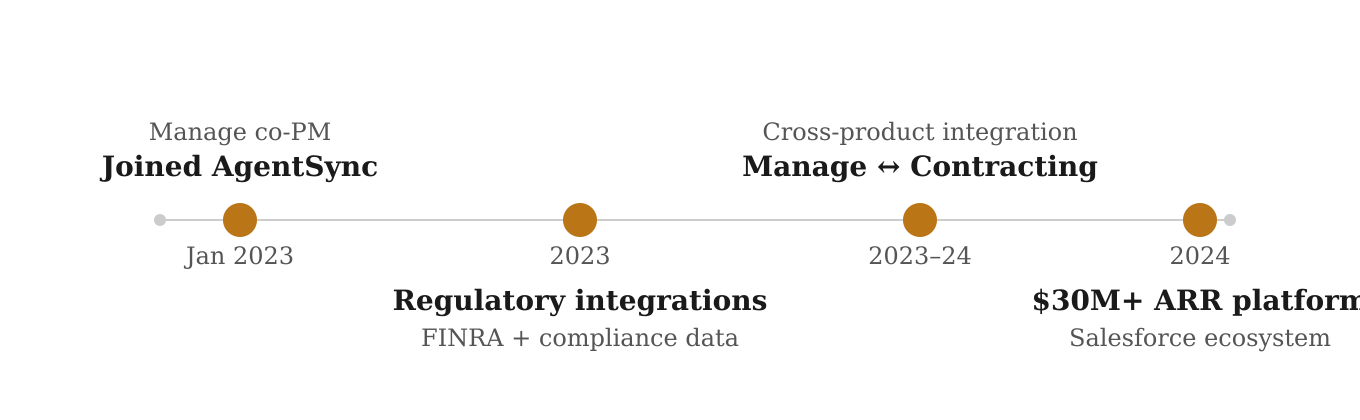
AgentSync Manage · Manage PM, Data, Platform & Integrations · Jan 2023–2024
The problem I owned
The data and integrations layer of a compliance product is where the real complexity lives. Insurance producer compliance isn't a static dataset — it's a constantly shifting surface of state licensing requirements, regulatory body filings, appointment statuses, and continuing education records, all of which have to be accurate in near-real-time or the product fails its core promise.
My mandate covered three interconnected problem areas: integrating with regulatory bodies like FINRA to keep compliance data current and reliable; building and maintaining the integration between Manage and the Contracting product so data flowed cleanly across both surfaces without manual reconciliation; and ensuring the platform layer underneath all of this was stable and extensible enough to support both product lines as they grew.
Context
AgentSync Manage was the company's flagship product — the compliance operating system that insurance carriers, agencies, and MGAs used to manage producer licensing, appointments, and regulatory workflows. At $30M+ ARR, it was the revenue foundation everything else was built on. I joined AgentSync as one of two PMs on Manage, with a defined mandate: own the data, platform, and integrations layer of a product whose surface area was too large for any single PM.
Manage was built as a Salesforce managed package — meaning the product lived inside the Salesforce ecosystem, and every architectural and product decision had to account for what that platform allowed, constrained, and made possible. I had to learn that ecosystem deeply and quickly.
What happened
Manage retained and grew its position as the company's core revenue driver, reaching $30M+ ARR across the customer base. The regulatory integrations strengthened the product's compliance guarantee — the core value proposition for every carrier and agency customer on the platform. The Manage ↔ Contracting integration became foundational infrastructure that both product lines depended on as Contracting scaled.
I was the only PM at AgentSync who worked across all three teams over three years. That breadth wasn't accidental — it reflected a deliberate organizational decision to put someone adaptable at the connective tissue between products.
What I did
On the regulatory integration side, I led the work to connect Manage with FINRA and other compliance data sources — building ingestion pipelines that kept producer licensing and regulatory data accurate across the platform. In insurance distribution, stale compliance data isn't just a product quality issue — it's a legal liability for carriers. Getting this right required understanding both the technical architecture and the regulatory context, which is where my legal background was genuinely useful rather than incidental.
On cross-product integration, I owned the data bridge between Manage and Contracting — letting contract status, producer hierarchy, and appointment information flow between the two products without duplication or drift. This was particularly complex because Manage and Contracting were built on different underlying architectures, and keeping them in sync as both products evolved required sustained coordination across two product and engineering tracks simultaneously.
On the platform side, working within the Salesforce managed package model meant internalizing a set of constraints that shaped every technical decision. I invested heavily in understanding the Salesforce ecosystem — its data model, its governor limits, its deployment and versioning patterns — so I could make product decisions that were realistic given the platform rather than aspirational despite it.
What I'd do differently
Co-stewarding a product of this scale requires a more explicit operating agreement than we had at the start — on decision rights, roadmap ownership, and how to handle moments where two product tracks pull in different directions. We figured it out, but cleaner upfront definition would have saved real time.
On the platform side: the Salesforce architecture created constraints we treated as fixed. With today's AI tooling, I'd revisit that assumption. FINRA ingestion and compliance checks were largely batch processes. An AI-powered anomaly detection layer could make those pipelines real-time — flagging compliance drift before it becomes a violation, rather than surfacing it in the next scheduled sync. The infrastructure I built would have supported that upgrade. The product vision just hadn't caught up yet.